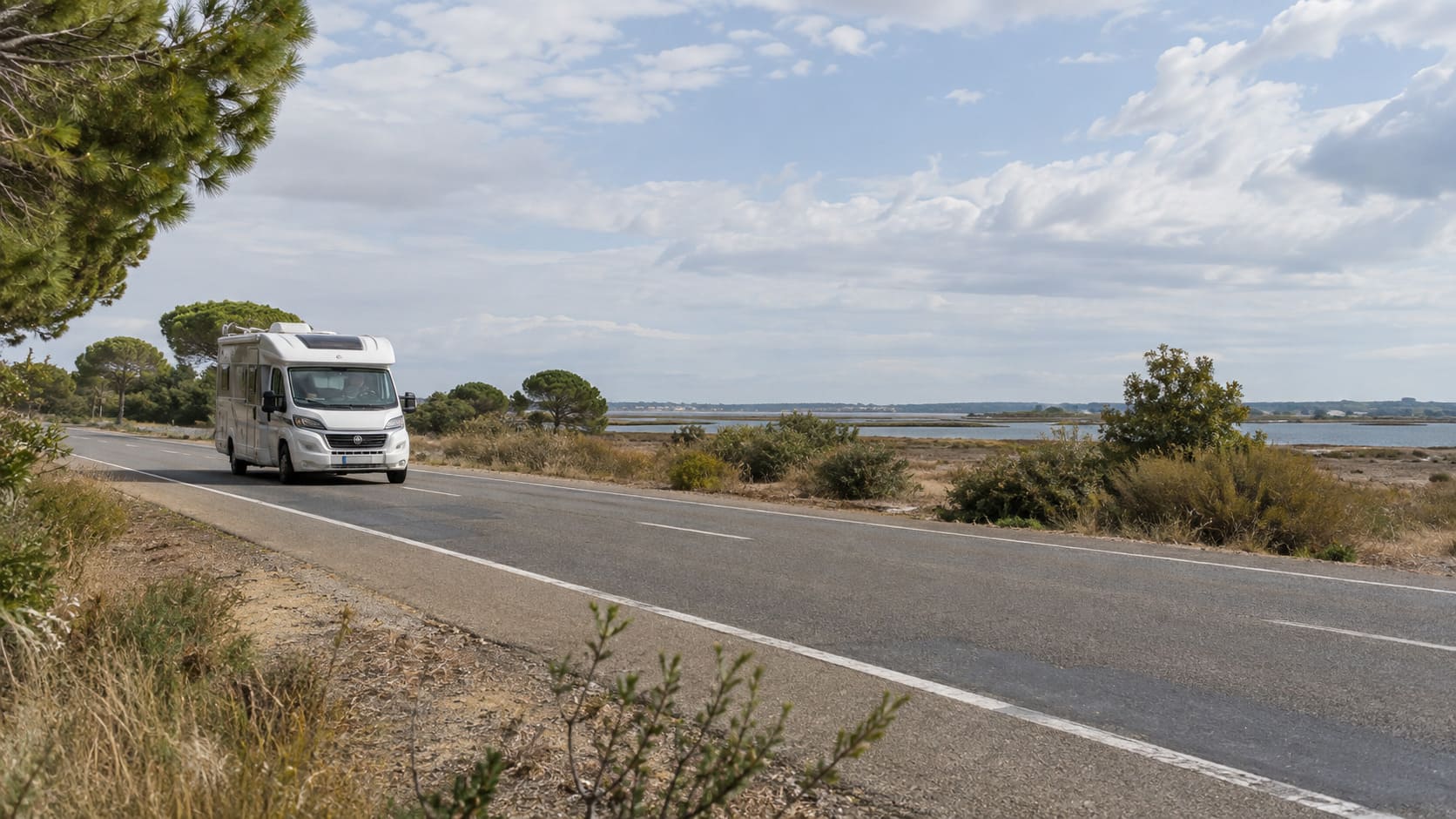
Exploring Huelva in a motorhome allows you to take in, in a single trip, the beaches stretching out to the Atlantic and the fishing villages of the Costa de la Luz in Huelva to the pastures, forests and mountain villages of the interior. Between these two landscapes lie marshes, sites linked to Columbus’s voyages, a village on the outskirts of Doñana, a walled town and a mining region with a character rarely found elsewhere.
This motorhome route through Huelva starts and ends at Camper Park Playas de Luz, next to the Isla Cristina Marshes. It isn’t organised into fixed-day itineraries: you can choose just the coastal section, add Doñana and the Colombino sites, or complete the inland route as far as Riotinto and the Sierra de Aracena. The idea is that you tailor your stops to the time you have available, the time of year and your preferred way of travelling.
A flexible itinerary for exploring the province of Huelva by motorhome
The proposed itinerary follows this order:
- Playas de Luz, Isla Cristina and Ayamonte Camper Parks.
- Islantilla, La Antilla and El Rompido.
- Punta Umbría and the Odiel Marshes.
- Huelva city and the sites associated with Columbus.
- El Rocío and the Doñana area.
- Fog and the Riotinto region.
- Aracena and the villages in the mountains.
- Return to Camper Park Playas de Luz.
You don’t need to stop at every point. If you’re short on time, you can drive along the coast between Ayamonte and Huelva and return to the area. If you’d prefer a more comprehensive route, carry on towards Doñana, head up to the mining basin and finish in the Sierra de Aracena before returning to the western coast.
Starting point: Camper Park Playas de Luz, Isla Cristina and Ayamonte
Before setting off on your journey, Camper Park Playas de Luz allows you to prepare your vehicle and plan your route from Pozo del Camino, between Isla Cristina and Ayamonte. The site has pitches for motorhomes of various sizes, electricity, drinking water, a waste disposal and water refill area, showers, a launderette and other facilities services and facilities for motorhomes useful before setting off on several journeys.
The immediate surroundings are well worth a visit. The Isla Cristina Marshes form a landscape of tidal inlets, salt pans and watercourses shaped by the tides. You can explore the area on foot or by bike along some of the nearby routes, taking in sights such as the El Pintado Tidal Mill, the Salinas del Duque salt flats and the Vía Verde del Litoral. If you’re particularly interested in nature, our guide to Birdwatching from a motorhome in Huelva highlights the most interesting places and times for birdwatching.
Isla Cristina offers the atmosphere of its harbour, its fishing heritage and the promenades along the estuary. From there, the route can take you to Ayamonte, situated beside the River Guadiana and the Portuguese border. In the town centre, you can explore the Plaza de la Laguna, the Paseo de la Ribera and the streets leading up to the oldest parts of the town. The municipal tourist office provides up-to-date information on heritage sites, car parks and local services, which is particularly useful if you’re visiting the centre in a large vehicle.
Camper Park serves as both the first and last stop: it allows you to set off with your vehicle fully prepared and, on your return, to rest and carry out any necessary maintenance.
From the beaches of Lepe to El Rompido
The next section heads towards Islantilla, La Antilla and El Rompido. Islantilla and La Antilla beach offer a more urban atmosphere and are close to amenities, whilst El Terrón provides easy access to the mouth of the River Piedras. To choose the right spot depending on the time of year and the sort of day out you’re planning, you can check out our selection of the best beaches in Huelva.
El Rompido retains a strong seafaring identity around the River Piedras. Opposite the town lies the Flecha de El Rompido, a sandy formation forming part of the Marismas del Río Piedras y Flecha del Rompido Natural Area. Access to its beaches is usually by boat from the local area, but availability and frequency depend on the season and sailing conditions. It is advisable to check the service before setting off.
Your stop can be limited to a stroll along the river, or extended to include both the beach and the countryside. During the high season, it is advisable to find a suitable car park in advance and avoid the narrow or congested streets along the coast.
Punta Umbría and the Odiel Marshes
From El Rompido, the route continues through Nuevo Portil and El Portil to Punta Umbría, where the Atlantic beaches coexist with wetlands and areas such as the Enebrales. Before reaching Huelva, the Marismas del Odiel Nature Reserve, formed at the confluence of the Tinto and Odiel rivers, is well worth a visit. As this is a protected area, you must use the authorised access points and facilities and follow the signposted routes.
If you’re bringing bikes, this part of the province also offers a range of options for combining motorhome travel with cycle touring. In our guide to EuroVelo on the Huelva Coast We outline various connections between Ayamonte, Huelva and the Doñana area, along with some points where the cycle route requires alternative routes.
Huelva city and the sites associated with Columbus
In Huelva city centre, a visit can focus on the Riotinto Company Quay, the Reina Victoria neighbourhood and the Casa Colón. These sites form part of the official tour of the city’s British heritage.
From the capital, the route continues towards Palos de la Frontera and La Rábida. The Muelle de las Carabelas is home to replicas of the Niña, the Pinta and the Santa María, and the Monastery of La Rábida rounds off one of the main attractions of the Columbian Sites. It is advisable to check opening times and activities before setting off.
For a short route, you can head back towards the west coast from Palos. If you have more time, the road to Mazagón opens up the route to Doñana.
Mazagón, El Rocío and the Doñana area
Mazagón links the Columbian Sites with Doñana via a coastline of pine forests, dunes and sandy cliffs. Some access points to natural beaches require walking along footbridges and paths; it is advisable to check the car park beforehand and avoid untried forest tracks.
The next stop is El Rocío, in the municipality of Almonte. Its sandy streets, the chapel and the marshland offer a very different view from the coast. During the Pilgrimage, the Rocío Chico and other large-scale events, special arrangements are in place: check the official notices and the car parks designated by Almonte Town Council before travelling there in your motorhome.
Visiting El Rocío does not mean you are free to explore the interior of Doñana National Park as you please. You must use designated visitor centres, public footpaths and authorised facilities. El Acebuche, La Rocina and the Palacio del Acebrón are official facilities where you can obtain information; some excursions into the park require authorised vehicles and a booking.
Please stay on the designated tracks, keep your distance from wildlife and do not drive onto restricted tracks.
Niebla: a walled town on the banks of the River Tinto
From the Doñana area, the route turns inland. Niebla is a natural stop to introduce visitors to the area’s historical heritage before entering the mining region. Its walled enclosure and the Castle of the Guzmanes form a major part of the visit and offer an insight into the traces left by different historical periods.
The old town is best explored on foot. Leave your motorhome in a designated area away from the narrow streets and check the signage and opening hours at the castle when you arrive.
The River Tinto serves as a guiding thread through to the next stage and on to where it joins the River Odiel near the city of Huelva.
The Riotinto Mines: industrial heritage and a unique landscape
The Riotinto region plays a key role in the economic and social history of Huelva. The Riotinto Mining Park divides the tour into several stops, including the Mining Museum, Casa 21, the tourist railway and mining sites, access to which depends on the type of ticket and the day’s programme.
The activities take place at different locations, have specific times, and some may be fully booked. The Mining Park recommends planning ahead and allowing time between them. If you only have a few hours, it is best to choose one or two activities.
Take in the scenery from authorised tracks and viewing points: not all mining tracks are open to tourists.
Aracena and the Huelva Mountains
The final major stage winds its way up towards the Sierra de Aracena and Picos de Aroche Natural Park, passing through pastures, chestnut groves, villages and mountain roads. Adjust your driving to suit the size of your vehicle, avoid taking shortcuts along narrow roads, and check for parking before entering the historic town centres.
Aracena is the main point of interest. The Gruta de las Maravillas, the fortified enclosure and the Ham Museum mean you can spend anywhere from a few hours to a full day here. Entry to the cave is by timed slots and subject to capacity limits, so it is advisable to book via their official channel, particularly at weekends and during peak periods.
To extend the stage, you can choose between Alájar, Fuenteheridos or Galaroza. It’s better to explore one or two at a leisurely pace than to rush from one place to the next. Our guide to walking routes in Huelva It brings together options from the coast, the mountains, Doñana and Riotinto.
Return to Camper Park Playas de Luz
From the mountains, the return journey to Pozo del Camino completes the circular route. This final stage can be completed directly or include a stop in one of the villages in the Andévalo region, provided that time and road conditions allow.
Returning to Camper Park Playas de Luz gives you the chance to empty your waste tanks, top up your water, do your washing, have a rest and check your vehicle before carrying on. You can also plan to visit Isla Cristina, Ayamonte, the marshes or go for a bike ride at the end of your trip.
Where to park and stay overnight along the route
The route passes through local authorities with different by-laws, road signs and traffic control measures. Instruction PROT 2026/04 issued by the Directorate-General for Traffic states that, as a general rule, motorhomes may stop and park under the same conditions and subject to the same restrictions as other vehicles. However, municipal regulations and the specific restrictions in each locality must be observed.
Parking does not entitle you to occupy the surrounding area. Placing tables, chairs or awnings outside the vehicle, spilling liquids or extending beyond the vehicle’s perimeter may turn a parking stop into a camp-out, which must take place at campsites, designated areas or spaces where this is permitted. Additional restrictions may apply in protected areas, on beaches and during special events.
For overnight stops, you can use council-run sites, private sites or campsites near the stages. As their availability, facilities and conditions may change, please check the official information or contact the site directly before making a detour. The aim is to avoid relying on a site that may be closed, fully booked or subject to temporary restrictions.
Tips for planning a motorhome route around Huelva
As well as adapting the stages to suit your own pace, it’s a good idea to check these Tips for travelling in a motorhome Before setting off, bear in mind the specific features of the route through Huelva:
- Don’t plan too many stops. The coast, Doñana, Riotinto and the mountains could each be worth several days’ travel on their own.
- Book visits with capacity limits or specific time slots in advance, particularly for Doñana, the Mining Park and the Gruta de las Maravillas.
- Check the weather forecast. In summer, the heat inland means it’s best to plan your visits for first thing in the morning; on the coast, the wind can also affect your beach plans.
- Check access routes and car parks before entering historic centres or nature reserves.
- Take enough water with you, but only fill up and empty your water containers at authorised facilities.
- Please respect the environmental signage and avoid straying from the paths open to the public.
- If you’re travelling during the peak season or at times such as the Romería del Rocío, check the special traffic arrangements.
Huelva by motorhome: a trip with many possible itineraries
Exploring Huelva in a motorhome means you don’t have to choose between the coast and the inland areas: it allows you to visit the Isla Cristina marshes, the Costa de la Luz, the British and Columbian heritage sites, Doñana, Riotinto and the mountain villages.
The route can take a few days or turn into a leisurely journey. Choosing fewer stages and allowing time for walking or exploring a village usually makes for a more fulfilling experience.
Camper Park Playas de Luz allows you to set off on your journey with all the necessary facilities and return to the same spot when you’re finished. If you then want to extend your trip to Portugal, you can also combine it with our a motorhome tour of the Algarve. Check the availability of pitches and plan your next motorhome trip around Huelva right here.
Frequently asked questions about the Huelva motorhome route
How many days does it take to explore Huelva in a motorhome?
There is no set duration. The coastal stretch can be organised as a short break, whilst including the city of Huelva, the Colombino sites, Doñana, Riotinto and the Sierra de Aracena requires more time. The route is designed so that you can choose which sections to cover, rather than following a fixed itinerary.
Can you do the route all year round?
Yes, but you need to adapt your plans to the season. In summer, it’s best to avoid the midday hours indoors and expect busier conditions on the coast. Spring and autumn are usually good times to combine nature and cultural visits, whilst winter allows you to enjoy many destinations with fewer visitors, although some services may have reduced opening hours.
Can I spend the night in any car park?
This should not be taken for granted. Motorhomes may generally park in the same way as other vehicles, but must always comply with road signs, local by-laws and any restrictions on parking spaces. Wild camping is only permitted in designated areas.
Is it compulsory to book visits?
It depends on the attraction, but it is advisable for activities with set opening times and capacity limits, such as certain tours of Doñana, the Riotinto Mining Park or the Gruta de las Maravillas. You should always check their official channels before setting off.
Where does this route start and end?
The route begins and ends at Camper Park Playas de Luz, in Pozo del Camino. From there, you can first explore the west coast, continue on to Huelva and Doñana, then head into Riotinto and the Sierra de Aracena, and finally return to the campsite.
 English
  Spanish
  French
  German
  Dutch
Dutch